English Heritage Locations in The Lake District. English Heritage cares for over 400 historic buildings, monuments and sites – from world-famous prehistoric sites to grand medieval castles, from Roman forts on the edges of the empire to a Cold War bunker. Through these, we bring the story of England to life for over 10 million people each year.
Here we focus on English Heritage locations in the incredible Lake District National Park.
Castlerigg Stone Circle, Keswick
 Castlerigg Stone Circle is one of the most visually striking prehistoric monuments in the United Kingdom due to its dramatic natural setting. It’s located near Keswick in Cumbria, in the heart of the Lake District National Park, surrounded by a panorama of mountains.
Constructed during the Late Neolithic and Early Bronze Ages, around 3000 BC, it is among the earliest British circles. The main circle has a diameter of approximately 30 meters and consists of 38 stones, with a rectangular ‘sanctuary’ of 10 stones set within it. The largest stone measures around 2.3 meters high.
While the original purpose of the site isn’t entirely known, it is thought to have been used for ceremonial or ritualistic purposes. Some researchers believe that the site could have been used for astronomical observations, as certain stone alignments seem to correspond with particular solar and lunar events.
The circle has a powerful presence in the landscape, and it’s easy to imagine how it must have been a significant place for prehistoric communities. Today, it continues to hold a strong allure for visitors who come to experience its ancient mystique and enjoy the extraordinary views.
Managed by the National Trust and English Heritage, Castlerigg Stone Circle is freely accessible to the public. Given its archaeological importance, it’s a Scheduled Ancient Monument, protected by law against unauthorised change. Despite its age, the stone circle remains largely intact, offering a fascinating insight into the distant past.
Other stone circles in the Lake District include Swinside Stone Circle.
Ambleside Roman Fort
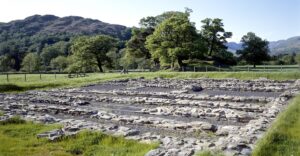 Ambleside Roman Fort, also known as Galava, is a historic archaeological site located in Ambleside, in the Lake District of England. It was built by the Romans near the northern end of Windermere, England’s largest natural lake. The fort was strategically placed to aid the Romans in controlling the local population and managing resources in the area.
Established around 79 AD, during the rule of Emperor Vespasian, the fort housed about 500 soldiers and remained in use until the early 4th century AD. Its design was typical of Roman forts, with a rectangular layout and defensive walls enclosing buildings like the commandant’s house, granaries, and barracks.
The fort is now largely in ruins, but the layout is still clearly visible. Some stone foundations of the buildings have been exposed and are preserved. They provide an interesting insight into the structure of the fort and the daily lives of the soldiers who were stationed there.
The site is managed by the National Trust and is open to the public. Although only the foundations remain, information boards around the site help visitors to understand the fort’s layout and history. Given its unique location near Lake Windermere and the town of Ambleside, the fort is a popular stop for people exploring the Lake District’s rich historical and natural attractions.
Hardknott Roman Fort
 Hardknott Roman Fort, known to the Romans as Mediobogdum, is one of the most dramatically located Roman forts in Britain. Situated in the Lake District in Cumbria, England, the fort sits on a steep-sided, rocky outcrop at the Hardknott Pass, with an elevation of 800 feet (244 meters), offering panoramic views over Eskdale.
Constructed between 120 and 138 AD, during the reign of Emperor Hadrian, the fort was intended to protect the strategic Hardknott Pass, which formed a key link in the Roman road network connecting the coastal fort at Ravenglass to Ambleside and the wider Roman Empire.
The fort was designed to house a garrison of around 500 soldiers and included a commandant’s house, barracks, bath house, and granaries within its stone walls. The fort was abandoned by the Romans around the early 3rd century AD, and much of the stone was later repurposed for local building work.
Today, the remains of the fort provide an evocative glimpse into the past. Although the walls are largely reduced to foundations, the site’s plan can still be discerned. The remnants of the headquarters building and the bathhouse are particularly noticeable.
Managed by English Heritage, Hardknott Roman Fort is open to the public and free to visit. However, visitors should be aware that the fort is located on a challenging mountain pass and can be difficult to access. The area’s weather can also be unpredictable, and appropriate precautions should be taken when planning a visit.
Ravenglass Roman Bath House
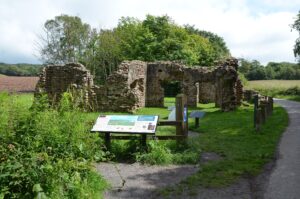 Ravenglass Roman Bath House, also known as Walls Castle, is one of the best-preserved Roman structures in England. Located in the village of Ravenglass in Cumbria, the structure was part of a larger Roman fort and naval base known as Glannoventa. This was built around 130 AD to manage the important local supply of iron ore and support the Roman Navy in the area.
The Bath House, specifically, served as a vital part of the Roman lifestyle. It provided a place for the soldiers stationed at the fort to bathe, relax, and socialize. The standing ruins that exist today were once part of a larger complex, including hot rooms, cold rooms, and a furnace. With walls standing at almost 4 meters high, it is an impressive example of Roman architecture. The structure’s survival over nearly 2,000 years offers valuable insights into Roman military and cultural practices.
In the present day, Ravenglass Roman Bath House is managed by English Heritage, and it’s open to the public for visits. It’s a popular tourist destination, offering a tangible connection to the area’s Roman history.
Stott Park Bobbin Mill
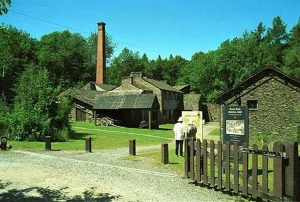 Stott Park Bobbin Mill is a historic site located in the Lake District of Cumbria, England. This preserved Victorian mill, built in 1835, is unique for its production of wooden bobbins, an essential component for Lancashire’s booming textile industry during the Industrial Revolution.
The Mill was strategically located to take advantage of the plentiful resources necessary for bobbin production: it was surrounded by coppiced woodland, which provided a sustainable source of wood, and it was situated near the shores of Lake Windermere for water power. The Mill used steam power and later electricity in the final years of operation.
At its peak, the Mill employed a workforce of up to 50 people and produced millions of bobbins each year. The products were used in spinning mills to hold thread during the process of weaving cloth.
Stott Park Bobbin Mill ceased production in 1971, marking the end of an era. Today, it’s a designated Scheduled Ancient Monument and is cared for by English Heritage. The site has been restored to full working order and offers guided tours to visitors, who can learn about the mill’s operation, the lives of its workers, and the broader history of the Industrial Revolution in the UK. This rare example of a surviving bobbin mill presents a fascinating look at a vital part of Britain’s industrial past.

“One more fell from a great mood…” Chris writes for numerous online publications, having studied at The University College of North Wales, Bangor. He is regularly in The Lake District and enjoys wild camping, hiking and watersports. His favourite location? Muncaster Castle…