

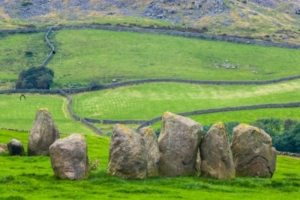
Swinside Stone Circle
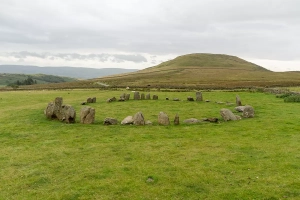
Swinside Stone Circle, also known as Sunkenkirk, is a prehistoric site located in the south-west corner of the Lake District, in the ancient district of Millom. The circle is composed of 55 stones, ranging in height from 1.5 metres to 3 metres, forming a near-perfect circle of about 29 meters in diameter.
Swinside is considered one of the most important stone circles in Cumbria, along with Castlerigg and Long Meg and Her Daughters. It is estimated to date back to either the Neolithic or Bronze Age, making it over 4,000 years old. Despite its age, the circle remains in remarkably good condition, and visitors can still see the stones in their original positions.
Visiting Swinside Stone Circle can be a unique and awe-inspiring experience. The circle is located on private ground, but it can easily be viewed from a nearby public footpath. Visitors can take in the stunning views of the surrounding fells while contemplating the mysteries and history of this ancient site.
More About Swinside Stone Circle
Swinside Stone Circle: A Guide to the Mysterious Ancient Monument in The Lake District
Swinside Stone Circle, also known as Sunkenkirk, is a prehistoric site located in the south-west corner of the Lake District, in the ancient district of Millom. The circle is composed of 55 stones, ranging in height from 1.5 metres to 3 metres, forming a near-perfect circle of about 29 meters in diameter.
Swinside is considered one of the most important stone circles in Cumbria, along with Castlerigg and Long Meg and Her Daughters. It is estimated to date back to either the Neolithic or Bronze Age, making it over 4,000 years old. Despite its age, the circle remains in remarkably good condition, and visitors can still see the stones in their original positions.
Megalithic specialist Aubrey Burl called Swinside “the loveliest of all the circles” in north-western Europe. In his study of the stone circles of Cumbria, archaeologist John Waterhouse commented that Swinside “can be compared only to Castlerigg and Long Meg and her Daughters in its visual impact; but its charm – for great charm it undoubtedly has – is greater even than theirs.”
Visiting Swinside Stone Circle can be a unique and awe-inspiring experience. The circle is located on private ground, but it can easily be viewed from a nearby public footpath. Visitors can take in the stunning views of the surrounding fells while contemplating the mysteries and history of this ancient site.
History
The Swinside Stone Circle is a Neolithic or Bronze Age monument located in the south-west corner of the Lake District in the ancient district of Millom, 5 miles north of the town of Millom. The circle consists of 55 stones set in a ninety-foot diameter circle. Archaeological investigation into the monument began in the early 20th century, with an excavation taking place in 1901.
British civilization underwent a number of important shifts throughout the Late Neolithic. Between 3500 and 3300 BC, prehistoric Britons ceased their continuous expansion and cultivation of wilderness and instead concentrated on settling and farming the island’s most agriculturally productive areas: Orkney, eastern Scotland, Anglesey, the upper Thames, Wessex, Essex, Yorkshire, and the Wash river valleys.
This time was also marked by what archaeologists see as a shift in religious beliefs throughout Britain. Communities stopped erecting enormous chambered graves for the deceased and instead began erecting large timber and stone circles. Aubrey Burl, a well-known megalithic scholar and archaeologist, suggested that the shift from erecting graves to creating open-air rings marked a shift in religious belief for the peoples of northwestern Europe. “There was a change from the cramped, gloomy chamber or tomb to the unroofed, wide ring, a change from darkness to light, from the dead to the living, from the grave to the sky,” he observed.
Construction
The stones used to construct the circle were brought from nearby areas and were erected in their current positions using a variety of techniques. Some of the stones were placed in shallow pits, while others were set directly into the ground. The largest stone in the circle is over 2.5 meters tall and weighs over 16 tons. It is believed that the circle was constructed over a period of several hundred years, with some stones being added or removed over time.
Swinside was built using porphyritic slate obtained from the nearby fells, and the stones were known locally as ‘grey cobbles’ by the twentieth century. The ring has a diameter of roughly 93 ft 8ins (26.8m) and now comprises 55 stones, however there were probably around 60 when it was first built.
Swinside’s builders included a “well defined” 2.1 m (7 ft) wide entrance on the south-eastern side, which was signified by the placement of two massive portal stones outside the circle’s ring. Other stone circles in the Lake District with portal entrances are Long Meg and Her Daughters. These characteristics can also be found in stone circles in Dumfriesshire. Swinside, in particular, has certain characteristics with the Girdle Stanes.
Purpose
The purpose of the Swinside Stone Circle is not entirely clear. Some believe that it was used for religious or ceremonial purposes, while others think that it may have been used as a meeting place or as a way to mark the changing seasons. The circle’s location, in a natural amphitheatre surrounded by hills, suggests that it may have been used for communal gatherings or rituals.
It is also possible that the circle was used as a way to mark the passage of time. The circle is aligned with the movements of the sun, and it is thought that the stones may have been used to track the changing seasons and the phases of the moon.
Folklore
In the Early Modern period, local folklore about the stones held that they had once been used in the construction of a church, but that the Devil continually thwarted these plans, creating the stone circle in the process.
Features
Layout
The Swinside Stone Circle, also known as Sunkenkirk, is located on Swinside Fell in Cumbria. It is a near-perfect circle, measuring approximately 29 meters in diameter, with 55 stones ranging from 1.5 to 3 meters in height. The stones are made of local slate and are set on a foundation of packed pebbles. The circle is oriented to the southeast, with an entrance on this side.
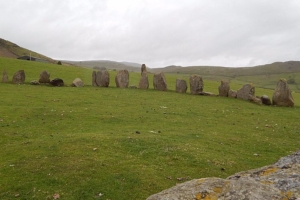
The stones of the circle are not evenly spaced, with some standing close together and others spaced further apart. The circle is surrounded by a low bank, which is interrupted by the entrance on the southeast side. The bank is highest on the northeast side, where it reaches a height of approximately 1 meter. The circle is located on private ground, but it can be viewed from a nearby public footpath.
Stones
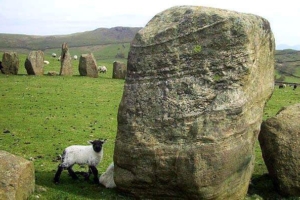
The stones of the Swinside Stone Circle are made of local slate and range in height from 1.5 to 3 meters. The tallest stone in the circle stands at approximately 3 meters and is located on the northeast side of the circle. The stones are not uniform in shape, with some being more rectangular and others more irregular in shape.
The stones of the circle are thought to have been carefully selected and placed in their positions. Some of the stones have been found to have markings on them, which may have been intentional or may have been caused by natural weathering over time. The stones are set on a foundation of packed pebbles, which has helped to stabilize them over time.
Significance
Swinside Stone Circle is considered one of the most significant prehistoric sites in Cumbria. The circle of stones is believed to date back to either the Neolithic or Bronze Age period, making it approximately 5,000 years old. The site is located in the south-west corner of the Lake District in the ancient district of Millom, 5 miles north of the town of Millom.
Cultural Importance
Swinside Stone Circle has significant cultural importance as it is believed to have been a place of spiritual and religious significance for the people of the time. The circle is believed to have been used for rituals, ceremonies, and gatherings. The circle’s location, surrounded by stunning natural beauty, adds to its cultural significance, as the landscape is believed to have played a significant role in the people’s spiritual beliefs.
Archaeological Importance
The Swinside Stone Circle is of great archaeological importance as it provides insight into the prehistoric culture and society of the time. The circle’s construction and design suggest a high level of skill and knowledge in engineering and astronomy. The circle’s alignment with the sun and moon suggests that it may have been used as an astronomical observatory. The stones’ arrangement and positioning also suggest that they may have been used to mark the changing seasons or to track the movements of celestial bodies.
Archaeological excavations and surveys have been conducted at the site, which has revealed evidence of human activity, including burnt bones, flint tools, and pottery fragments. The excavations have also revealed evidence of postholes and pits, which suggest that the site may have been used for a variety of different purposes over time.
Visiting
Swinside Stone Circle is a popular destination for visitors to the Lake District. Here are some key details to keep in mind when planning your visit.
Location
The Swinside Stone Circle is located in the Lake District National Park in Cumbria, England. It is situated near the town of Broughton-in-Furness and is easily accessible by car or public transport.
Address: Swinside Stone Circle, Broughton-in-Furness, Cumbria, LA20 6DJ, UK.
Accessibility
The Swinside Stone Circle is located on private land, but it can be easily viewed from a nearby public footpath. The footpath is well-maintained and suitable for most visitors, including those with mobility issues. However, visitors should be aware that the path can be muddy and slippery in wet weather.
There are no public toilets or other facilities at the site, so visitors should plan accordingly.
Guided Tours
Guided tours of the Swinside Stone Circle are available from a number of local tour operators. These tours provide visitors with a more in-depth understanding of the history and significance of the site.
Visitors who prefer to explore on their own can use a variety of online resources to learn more about the Swinside Stone Circle, including maps, guides, and historical information.
Highly Recommended Hotels Nearby

Muncaster Castle Coachmans Quarters
Muncaster Castle Coachman’s Quarters are now all self-catering with recently refreshed and redecorated rooms, all with private bathrooms and access to the huge communal kitchen,

Lakes Hotel & Spa
The Lakes Hotel & Spa is a luxurious hotel located in Bowness-on-Windermere, in the heart of the Lake District. This hotel offers world-class service and

The Pennington Hotel
This 16th-century estuary-front Pennington Hotel in Ravenglass, a former coaching inn, offers free Wi-Fi and fine local food in its brasserie-style restaurant. The en suite
Nearby Attractions

The Lakeside & Haverthwaite Railway
The Lakeside and Haverthwaite Railway is a heritage steam railway located in the beautiful Lake District in Cumbria, England. It operates along a 3.2-mile (5.1

Muncaster Castle
Muncaster Castle is a historic building and tourist attraction located near the village of Ravenglass in the western Lake District, Cumbria, England. The castle dates

Coniston Water
Length (km) Max Width (km) Area (km²) Volume (m³) Mean Depth (m) Max Depth (m) Surface Elevation (m) Coniston Water is a beautiful lake located
Latest News

Lake District Agricultural Shows 2026: The Complete Guide to Cumbria’s Country Shows
One of the best ways to experience the real Lake District is by visiting one of Cumbria’s traditional agricultural shows. These much-loved annual events celebrate

Lake District Agricultural Shows 2024
Agricultural shows in the Lake District are a vital part of Cumbria’s rural life. These events attract locals and tourists, boosting the economy and celebrating

Lodore Falls Hotel Wins Spa Award
In the heart of the Borrowdale Valley, the Lodore Falls Hotel & Spa has been named the Best Destination Spa at the 2024 Good Spa

Windermere: Britain’s Most Stunning View
Windermere, the largest natural lake in England, has recently been named Britain’s most stunning view. This accolade highlights the lake’s breathtaking beauty and cements its

Wild Haweswater Wins Global Award
The Lake District is famous for its beautiful landscapes and peaceful scenery. Recently, it has gained global attention for an amazing environmental project. The Wild

Laik Holiday Lettings Nominated
The Lake District is renowned for its stunning landscapes and tranquil atmosphere. It’s a top destination for nature enthusiasts and adventure seekers. Within this breathtaking