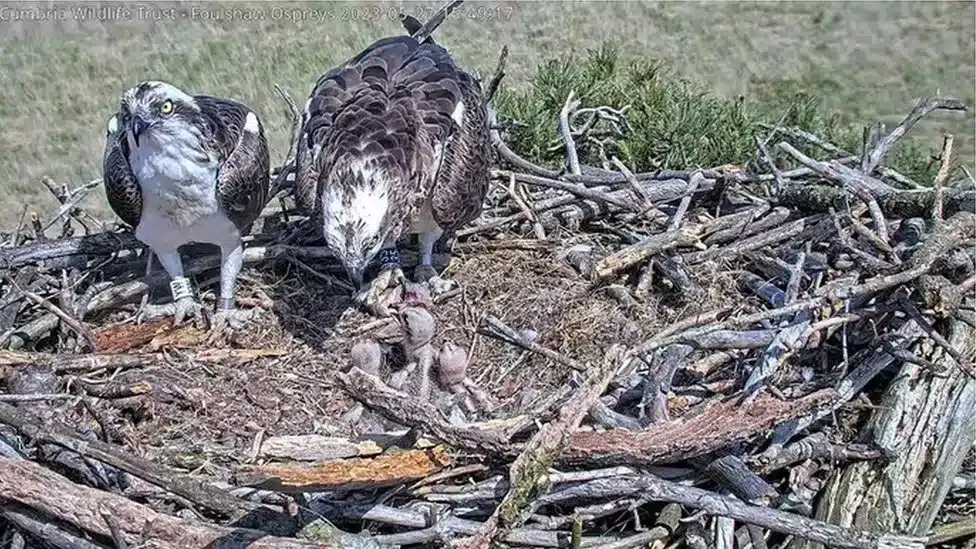
For the tenth year in a row, osprey chicks have hatched at a wetland nature reserve.
Blue 35 and White YW, the parents, originally nested at Foulshaw Moss near Witherslack in South Cumbria in 2013 and hatched their first chicks the following year.
They came in March after a 4,000-mile journey.
It was a “landmark moment,” according to Cumbria Wildlife Trust reserves officer Paul Waterhouse.
Ospreys were declared extinct in England in 1840, but were successfully reintroduced in the 1990s.
Each year, they move to Africa or Europe before returning to breed.
Every year, the adult ospreys reared two or three offspring on the spot, according to Mr Waterhouse.
“Blue 35 and White YW first arrived in 2013, following major habitat restoration at Foulshaw Moss Nature Reserve,” he explained.
“This large-scale conservation success story saw a 900-acre site, previously drained and used for commercial forestry and farming, being transformed back into the healthy wetland you see now, which is teeming with wildlife.”
Other birds of prey found in the reserve include the peregrine falcon and the marsh harrier.
The trust’s nest camera allows visitors to see the ospreys.
For the tenth year in a row, osprey chicks have hatched at a wetland nature reserve.
Blue 35 and White YW, the parents, originally nested at Foulshaw Moss near Witherslack in South Cumbria in 2013 and hatched their first chicks the following year.
They came in March after a 4,000-mile journey.
It was a “landmark moment,” according to Cumbria Wildlife Trust reserves officer Paul Waterhouse.
Ospreys were declared extinct in England in 1840, but were successfully reintroduced in the 1990s.
Each year, they move to Africa or Europe before returning to breed.
Every year, the adult ospreys reared two or three offspring on the spot, according to Mr Waterhouse.
“Blue 35 and White YW first arrived in 2013, following major habitat restoration at Foulshaw Moss Nature Reserve,” he explained.
“This large-scale conservation success story saw a 900-acre site, previously drained and used for commercial forestry and farming, being transformed back into the healthy wetland you see now, which is teeming with wildlife.”
Other birds of prey found in the reserve include the peregrine falcon and the marsh harrier.
The trust’s nest camera allows visitors to see the ospreys.

Kath Beattie studied Journalism at The University of Central Lancashire and now writes for several Travel publications. She recently moved to The Lake District and enjoys walking her 3 dogs every day across the fells.