We look at the regulations governing wild camping in the Lakes, provide expert advice, what gear to bring, and where to pitch your tent. Continue reading to discover why more people than ever before are enjoying camping in the wild and magnificent Lake District.
What exactly is wild camping?
Is this legal?
Wild camping is permitted in Scotland, but not in England or Wales, where all land is privately owned and campers must obtain permission to pitch a tent overnight.
However, this is often missed if you choose the correct location, such as the lonely mountain parts of Snowdonia and the Lake District.
Dartmoor is the one exemption to this law; provided you are not on a public road and are not in an enclosed area, you can camp for a maximum of two consecutive nights in the same place.
Lowland is not seen kindly and for good cause, according to the National Trust, a conservation foundation. “Our rangers spend hundreds of hours weekly clearing up litter and left-over equipment.”
So, how can you appreciate getting closer to nature and having an adventure when wild camping?
Follow The Rules!
When wild camping, the two most important things to remember are to choose the correct place and to leave the area precisely as you found it. These guidelines must be followed if you are going to wild camp. There is an etiquette you should follow!
- Travel light – because you can only stay one night in every location, a well-organized backpack should hold all you need. If it doesn’t, and you wish to carry extra gear, it might be a sign that a typical campground would be more suited to your needs.
- Remove your rubbish – It may surprise you to find that many campers do not pick up after themselves, which has an impact on the scenery and animals. Take all of your trash with you and inspect the place before you depart.
- Leave things as you found them – don’t leave any sign of your presence, don’t harm the environment, and if you need to use the lavatory, make sure it’s not within 30 metres of any water and that any waste is well-buried so it can biodegrade. (Don’t bury your toilet paper; instead, put it in sealable bags and carry it with you.)
- Fire – There’s a lot of debate regarding open fires when we urge you use a camping stove instead. While an open fire is great fun, they’re difficult to start in bad weather, and there’s always a tiny possibility you’ll be responsible for a big-scale conflagration in dry weather. If the ban on this form of camping is ever repealed, fire restrictions will almost certainly be imposed. (Plus, a fire gives away your location).
- Limit Numbers – To reduce noise and light pollution and to avoid disturbing wildlife, confine your party to one or two individuals.
- Arrive late, leave early, and spend only one night is the ideal practice.
What distinguishes wild camping from normal campsites?
When you arrive at an approved campground, you will be met with amenities such as toilets, electric hookup points, and showers. Some offer stores, Wi-Fi, bars, entertainment, and children’s play spaces.
While a variety of amenities is ideal for families, some of us prefer privacy, quiet, tranquillity, and the opportunity to relax, get close to nature, and watch the sunset without being crowded by other campers.
If you are willing to forego onsite conveniences; try it, it’s free; you will be rewarded with an experience unlike any other.
If you can’t live without your phone and require a shower every day, maybe wild camping isn’t for you!
What do you need to go camping? – fundamentals kit
Arriving at the ideal camping location only to discover that you lack a vital piece of equipment might spoil your holiday.
- Backpack – You’ll need a good quality backpack with a capacity of 35-60 litres, depending on how many nights you’ll be camping and how much gear you’ll bring. Make sure it’s light and, ideally, waterproof. It is worthwhile to invest a bit more since you do not want the seams to crack or to arrive to discover all of the contents saturated.
- Rucksack Liner – Not necessary, but it weighs very little and will protect your camping stuff if you get caught in a deluge.
- Bivy bag or tent – A bivy sack is a simple covering that protects you from the elements while you sleep in your sleeping bag. If you desire more space, we propose the lightweight Vango Nevis 200, which is suited for two people and weighs roughly 2kg.
- Sleeping mat – Because you will most likely be sleeping on rocky ground when wild camping, a sleeping mat is vital if you want to obtain a good night’s sleep. While not inexpensive, a self-inflating mat is well worth the money and provides insulation if the ground is chilly.
- Sleeping bag – Even in the summer, the fells may get cold, so a good sleeping bag is important while camping in the outdoors. Look for a lightweight one, not a duck down filled cocoon, because you’ll be carrying it around all day.
- Accidents happen, and while camping in isolated regions, the nearest doctor is likely to be miles away, therefore a first-aid pack is important. Pain relievers, bandages, safety pins, antiseptic cream or spray, blister therapy, imodium, scissors, tweezers, dressings, and tape should all be included.
- Swiss army knife – A useful instrument that can be used for everything from cutting vegetables and tent ropes to opening a bottle of wine.
- Sunscreen – Even when it’s not extremely hot, the sun may be powerful in the mountains.
- A map/compass – GPS is great, but mobile phone services can be spotty in the Lake District, and an old-fashioned map and compass can save you from getting lost.
- Wet wipes – You may be able to wash in a stream, but it will almost certainly be cold, so bringing a packet of wipes will allow you to go into a country bar without everyone wrinkling their noses.
- Lamp – You don’t want to be roaming about in the dark, so pack a head lamp, which frees up your hands and is ideal for late-night potty excursions.
- Water filter – You may purchase pills or the breakthrough Lifestraw, which weighs only 2 oz and filters 99.9999% of bacteria and parasites present in water, allowing you to safely drink from rivers and streams.
- Camping stove – Always use a stove instead of building a fire when wild camping. Fires can be dangerous. Insects require the restricted numbers of trees and decaying wood found in the fells. There are several options that are powerful, lightweight, and inexpensive.
- Pan – You’ll need a container to boil water for hot beverages and cook in, so seek for small and lightweight mess tins or specific camping pans.
- Thermal flask – A far superior option to plastic or metal cups for keeping beverages warm.
- Midges may be a nuisance during the summer months, especially near water, so have insect repellant on hand.
- Camera – While not required, it would be a pity not to capture the breathtaking vistas of the Lake District and take home memories of your camping vacation.
- A Trowel? I hear your question, and to put it mildly, you will need to bury your poo, and a lightweight trowel is the tool for the task, and on that note, don’t forget the loo paper!
What should I eat?
There are a plethora of dehydrated and boil-in-bag specialised camping foods to select from, and while they might be a little pricy, they provide a tremendous variety ranging from curries and all-day breakfasts to chocolate pudding. But what if you need a pick-me-up while trekking or want to eat without setting up camp? Here are some light snacks to bring with you.
- Cured meat
- Nuts (which are high in fat)
- Dried Fruit
- Breakfast sachets
- Cup a soup (in the morning, fill a flask with hot water for hot drinks throughout the day)
- Tea-bags and coffee sachets
- Dried Milk
- Kendal Mint Cake
- Granola Bars
If you know where you’re going and will be camping in the wilderness for a few days, a helpful tip is to send supplies to a local post office. There are few supermarkets and many small stores, however, they can be pricey.
Choosing the Best Location
Is Keswick suitable for camping?
Keswick is a prominent tourist resort located between Derwent Water and the breathtaking majesty of Skiddaw, England’s sixth highest peak. Surrounded by breathtaking surroundings, this little market town offers a fantastic selection of shops and restaurants, as well as a plethora of neighbouring sights and activities.
There are many official campsites nearby, and the region is popular with water sports enthusiasts, but if you want to go wild camping, avoid Derwent Water during the summer months.
A far better choice is to walk or cycle to Skiddaw and follow one of the routes up the mountain; the higher you go, the greater the scenery and the more probable you will discover a quiet area suited for wild camping.
Overnight parking
The greatest wild camping spots are inaccessible by automobile since they are located far from the road. That doesn’t mean you can’t drive or camp in a vehicle or RV and explore the region, possibly spending the night beneath the stars.
There are various car parks in the Lake District that allow overnight parking of both cars and motorhomes, but do your homework before you travel because some are free, others require a little price, and some do not allow you to stay in the vehicle.
There are also a number of bars that provide overnight parking for a charge or for the cost of a packet of crisps and a drink.
There are various laybys on the Honister Road heading towards Buttermere where you can generally locate campervans and RVs, however, they are best if you’re only planning a day walk.
Before you go
Wild camping may appear to be an unplanned way to experience the incredible beauty of the Lake District, but it will require forethought if you want to appreciate it truly, so do your study.
Here are some things to think about:
Are you driving or taking public transport?
- By Train – Windermere, Staveley, which is surrounded by wonderful walking terrain, Burneside, and Kendal are the principal railway stations. There are connections that will take you up to Penrith, and the western lakes are easily accessible if you go down the Cumbrian coast from Lancaster. Unless you are an experienced hiker, you should select a location that is no more than an hour or so away from the station.
- By Car – As previously noted, there are plenty of locations to park your vehicle, motorhome, or campervan in the Lake District, but it is helpful to have a list of these sites before you travel and, once again, select somewhere away from settlement, but not too far to walk.
Bus – You’ll be delighted to know that the Lake District is served by an excellent bus network, allowing you to travel the length and width of the region. Take the Coniston Rambler 505 or look out the most popular bus routes here. - By Bus – Travelling by bus provides many opportunities for wild camping; check out the routes, open Google Maps, and organise your trip with ease.
- Cycling – Many guests go by bike, and it is undeniable that it allows you to reach locations that other modes of transportation do not. However, remember that wild camping requires you to be very high up, so you may need to get off and push.There is a reason you selected to go wild camping; it might be the scenery, a romantic vacation, local hiking trails, or perhaps you want to photograph the scenery. For whatever reason, utilise the internet as a resource.
Check the weather
A little rain never deterred a wild camper, but it does make a difference when selecting the ideal wild camping location. If you know the weather is going to be rainy, as is often the case in the Lake District, find somewhere shielded from the elements, such as a forested area or bothy.
Arrival date and time
After you’ve decided on a location, you’ll need to plan your route so you don’t arrive too late; you don’t want to be strolling to your destination in the dark. Excellent advice is to arrive about an hour before sundown to set up camp, possibly grab a little to eat, and be seated with a hot drink or glass of wine when the sun sets. Bliss!
Remember that you must be elevated and distant from buildings, public walkways, bridleways, fields, and roads.
Essential Attire
Because the weather can be unpredictable, a pair of shorts and trainers will not suffice. If you’re going wild camping, you’ll have to do some trekking, so here are some essential articles of clothes you’ll need for comfort and safety.
“There’s no such thing as bad weather, but there is such a thing as a bad choice in hats.” – Chris Giles
- Hiking boots – A necessity for trekking this sort of terrain; it’s worth spending the additional money on excellent waterproof ones because the weather is unpredictable and the terrain may be marshy and rocky, particularly on the fells.
- Pants – You’ll need pants that are both comfortable and easy to dry; sports leggings are a wonderful option. Do not wear denim since it fails terribly on both counts.
- Waterproofs – No matter what you wear beneath, you’ll always need a waterproof jacket and pants; they may not be the newest fashion trend, but they’re necessary for camping in the Lake District.
- Walking socks – are warmer and more cushioned than conventional socks. (Pro tip: Merino wool socks are odour-resistant, moisture-wicking, cool in the summer and toasty warm in the winter.)
- Base Layers – A t-shirt in the summer, a thermal top in the winter, and a thick fleece are required, as the temperature decreases 1 degree for every 150 metres rise.
- Coat – A down jacket is essential in the cold.
- Hat – When camping in the wilderness, a hat is vital since you lose heat via your head.
- Gloves – If trekking in freezing weather is absolutely necessary, opt for a lightweight thermal, waterproof pair rather than bulky thick sheepskin mitts.
Wild Camping Locations to Consider
1. Fleetwith Pike

Grid Reference: NY 205141
Coordinates: 320584, 514178.
Closest Postcode: CA13 9XA
Height: 648m
OS Explorer map: OL4
One of the nicest places to relax and watch the sunset. Fleetwith Pike boasts a commanding view over Buttermere, while on the northern side, harsh grey rocks rise above the Honister Pass.
If you have a car, you may park for a little fee at Gatesgarth Farm. It is quite a climb, turn left towards Honister, then right opposite the signpost soon after the final house, then immediately left.
The terrain becomes steeper as you rise, but experienced hikers should be able to complete the trek.
There is only enough for one tent at the peak, so you may have to find another isolated spot to pitch, but the spectacular vistas, birdsong, and bright skies make the trek worthwhile.
The MBA (Mountain Bothies Association) operates a few of bothies. It can be cold at night, even in the summer, so bring your thermals.
2. Rosthwaite and Sprinkling Tarn

Grid Reference: NY 22780910
Closest Postcode: CA12 5XJ
Height: 598m
OS Explorer map: OL6
This tarn is one of the most well-known wild camping places in the Lake District, so you’re unlikely to have it all to yourself. The good news is that there is plenty of space to enjoy peace and quiet in the shadow of Scafell Pike.
Follow the B5289 from Rosthwaite for approximately 3km and turn left to Seathwaite right before Seatoller, where you may park your car. Continue upstream for 1.4km until you reach the Stockley footbridge and turn right up Seathwaite Fell. Styhead Tarn is about 1.5 km away, while Sprinkling Tarn is around 800 metres away.
Sprinkling Tarn has an island for diving and jumping into the water, making it popular with families with older children, and there are several private camping areas in the region.
3. Codale Tarn
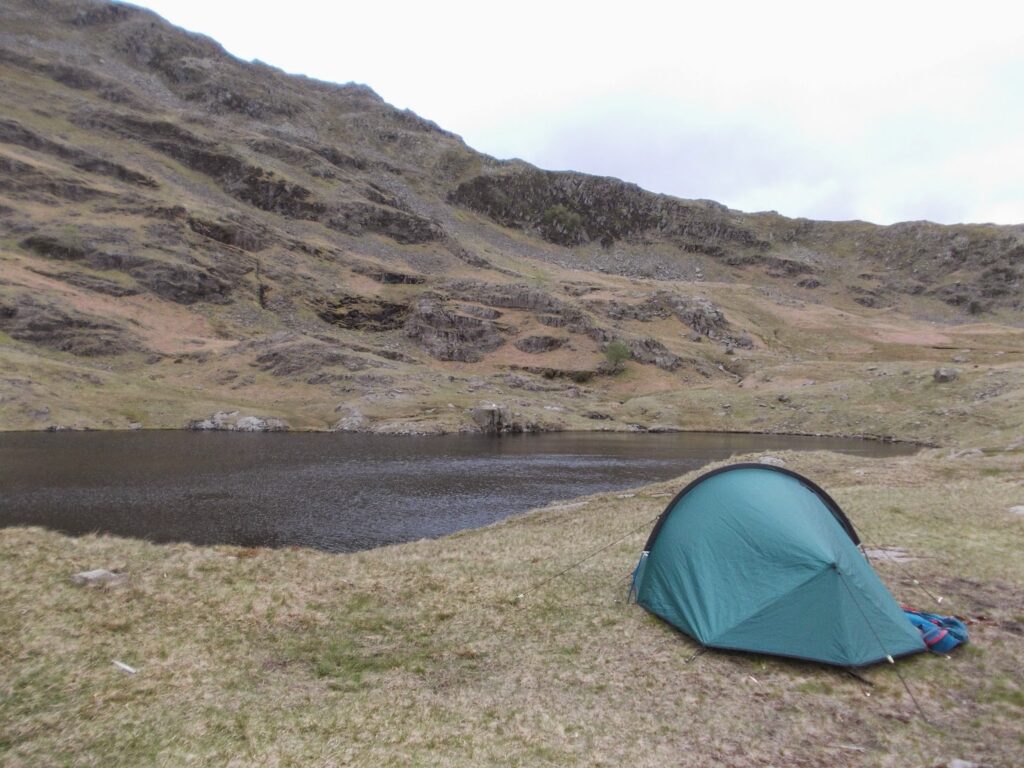
Grid Reference: NY 338077
Closest Postcode: LA22 9JU
Height: 467m
OS Explorer map: OL6
Codale Tarn is ideal for people seeking solitude because it has few tourists. It is a little isolated and getting there is not for the faint of heart, but it is well worth it to camp on the side of one of the nicest tarns with breathtaking views.
Only two and a half miles from Grassmere, the old home of poet William Wordsworth and a focus of tourist activity in the area.
Codale Tarn may be reached by hiking up from the town (via Easedale Tarn) or from Great Langdale. Scrambling is required, and the terrain can be muddy and swampy in parts.
A word of caution: the rocks near the waterfalls at Belles Knot are slimy, highly slippery, and can be quite dangerous.
4. Haystacks (Innominate Tarn)

Grid Reference: NY 19751294
Closest Postcode: CA13 9XA
Height: 525m
OS Explorer map: OL4
Haystacks, located in the south-east corner of the Buttermere Valley, is one of the most popular fells in the area for fishing, trekking, and camping.
Turn right and walk towards the shoreline from the National Trust parking park west of Buttermere. Then take a right and follow the creek that flows between Crummock Water and Buttermere. Cross this, then continue the path through the woods to the Scarth Gap trail for about a mile.
Look for another road leading from High Crags to Haystacks at the top of the pass; turn left and continue it up the western side of the fell.
Innominate Tarn, located near the peak, is a picturesque tarn with indents of little islands that lies 520 metres above sea level and gives spectacular views of the surrounding fells.
Some parts can be swampy, and it’s best to avoid a warm bank holiday weekend if you want privacy, but there’s a vast sweeping area at the peak where you can generally find a quiet nook to camp reasonably undisturbed.
5. Lingmoor Fell

Grid Reference: NY 3060 0426
Closest Postcode: LA22 9PD
Height: 411m
OS Explorer map: OL7
With a name derived from an old Norse term that means “heather-covered.” This lovely fall is only 5 miles from Ambleside and is located on one of the most popular Lake District camping routes, offering some of the greatest views of the Langdale peaks.
The approach is steep but not as difficult as some of the higher fells due to the excellent public transportation links between Ambleside and Great Langdale, which has a handful of pubs and a huge campground.
The ground can be marshy and there are stiles and barriers that make it unsuitable for any but the most athletic dogs. When you reach the peak, you will undoubtedly be thirsty.
6. Angle Tarn

Grid Reference: NY 4169 1439
Closest Postcode: CA11 0NY
Height: 563m
OS Explorer map: OL6
This hike ascends from Patterdale at the southern end of Ullswater to Angletarn Pikes. Many people consider Angle Tarn to be one of the most beautiful sites in the Lake District.
The hike begins with the Patterdale parking lot and ascends to the Boredale House. You then proceed to Stony Rigg and Angletarn Pikes.
From here, one can see all the way down to Angle Tarn, as well as the Helvellyn range and the Far Eastern Fells.
You then descend to the tarn for a section along the water’s edge before returning to Patterdale on the same path. Alternatively, you might continue on through the tarn and visit The Knott and Hayeswater.
Safety and Route Selection Go Hand in Hand
Wild camping in the UK will not have you waking up to find a bear or a wolf attempting to sneak into your tent, but it is not entirely risk-free. That is why you must plan ahead of time and take necessary safeguards.
Having a map and compass with you will help you avoid becoming lost. A phone is great, but chances are you’ll run out of battery or lose service. Even minor things like knowing that the sun sets in the west and rises in the east, or that moss grows better on the north side of a rock or tree, can aid with map reading.
You should always notify someone where you are going and when you expect to return so that if the worst happens and there is an accident or you become lost, search and rescue may be notified.
Remember that you will normally be a significant distance from medical care if you fall unwell or have an accident, and there may be no cell phone coverage, so bringing a basic first aid package is essential.
As previously said, you should always get permission to camp on someone else’s property, as there is always the possibility of being awakened up by an irritated landowner. Apologise calmly, offer them a modest sum of money, say £5, and don’t be cocky; after all, you’re breaking the law, and some of them have firearms!
You incur a modest chance of having your vehicle broken into if you park in rural regions. Find a secure parking spot, don’t leave valuables inside, and always lock your RV or car before venturing out.
The weather is without a doubt the most dangerous threat you will encounter (not a badger assault). This region is known for its heavy rainfall, and the weather in the winter may be unpredictable. Check the weather forecast before leaving, and always be prepared with appropriate attire. Heavy rain can cause flash floods, landslides, and snow, reducing visibility and making particular roads highly perilous. Winter, while beautiful, may be a hazardous environment and is not recommended for inexperienced wild campers.
FAQ’S
Is it legal to camp in the Lake District?
Apart from Dartmoor, wild camping is not permitted in England, however it is permitted in isolated areas like as the Lake District as provided as you stay away from houses, roads, public pathways, and lowland.
Where in the Lakes can you go wild camping?
Cumbria and the Lake District have over 200 fells and some of the most isolated regions in the nation, so there are lots of chances for wild camping.
Are open flames permitted when camping?
When wild camping, you must obtain permission to kindle a fire on someone’s property. In truth, you must get permission to camp, but while you may be permitted to pitch a tent, a fire will be seen unless you are in a very quiet spot.
Last words
Camping in the outdoors is a great way to reconnect with nature, clear your mind, and get away from the rush and bustle of contemporary life. Begin with a short journey, and if it all becomes too much, you may return home or to the next official campsite.
If you are intending to go wild camping in the Lake District, we hope the recommendations above will be useful. Just remember to pick a distant location near water that is also shielded from the weather, such as Angle Tarn.
Ready? Then grab your rucksack and travel to the lakes for an unforgettable trip!

Kath Beattie studied Journalism at The University of Central Lancashire and now writes for several Travel publications. She recently moved to The Lake District and enjoys walking her 3 dogs every day across the fells.